

The Resources
The tag line for this stream is “Practicing the Sacramental Life”. The material offered by the Renovare folks has two main teaching points. The first one is about the opposing pair work/faith, and explores some of the practical aspects of the sacred/secular separation that is still alive and well, active in our language, imagination, structures and relationships. The second one addresses the spiritual/material dualism which we are also very familiar with.
These are big pieces to explore and when I pause to consider some of the different ways I have experienced these dualities operating on my awareness it can get overwhelming really fast. I think we’ll have to do some pretty heavy lifting here, eventually, because we’re going to have to spend some time exploring what we understand about sin and evil so that, when we get to the part where we recognise how God meets us, joins with us and gathers us into their embrace, we are able to be present without the dragging shackles of dread and fear caused by guilt and shame.
So, let’s start with embodiment. It might seem a strange way to begin, and I’ve sat here for a while wondering if it makes any sense to start here, but the thing is – this is what has come to me in the past two weeks.
As you know, I’m nearing the end of an extremely busy month or so. I’ve had so many extra things happening that I haven’t actually had a good work/rest/play balance. (I hope you see what I did there). Most of the extras have been for the good and all of them things that I’ve consciously said yes to. The bonkers busy month is mostly about unfortunate timing more than it is about thinking I can do more than is humanly possible or energetically sensible.
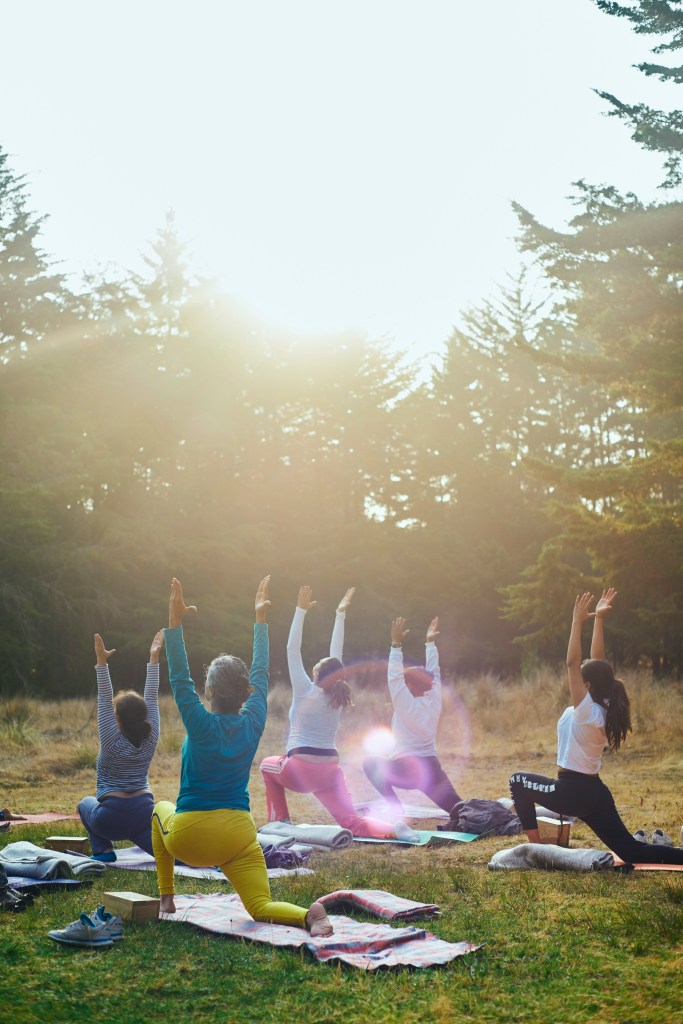
And when I talked to my supervisor about all the things and how stretched I feel she asked – of course – about what helps me stay grounded, centred, calm and clear. And I said two things: meditation practice and yoga. And while my prayer practice is well established so I rarely miss my daily sit, yoga is still an optional extra and when I’m feeling pressured it is the first thing to go from my day. EVEN THOUGH I KNOW that it feeds me in a way that nothing else I’ll do today will match. On the mat, I am that flow of breath and movement. I let the sensing of and into my body lead me into the quieting of my mind as I focus and lose myself in the moment so that I feel more fully aware and open and free to be…and so I can be compassionately, curiously present to what is still restricted, stuck or unresponsive.
This is where I am immersed in the incarnational stream. Whatever thinking or abstract theory or understanding I may want and need to frame and talk about holiness inhabiting material reality, undergirding that is an experience. Yoga returns me to it. I am not discovering this for the first time, or finding my way to a new territory. When I practice yoga I am returned to a time and an inner place, a when and a where I have already lived in unconscious awareness of life (being, existence) as sacred, infused with God’s presence, wholly holy.
Pause to reflect
What has been (or is now) your experience of this state of being? Have you ever had this sense? How are you (or have you been) drawn into the awareness of the everyday and ordinary as divine presence?
The Way is…shut
As I read the chapter on Jesus as the Way in Diana Butler Bass’ book ‘Freeing Jesus’, she reflects on the movement of her faith which took her down the dark path of conservative evangelicalism and its emphasis on Calvin’s theology of predestination which holds that God has already chosen those who will be saved and those who will be damned, as well as his lowest of the low view of humanity which claimed ‘total depravity’ and ‘there is no health in us’.
For Diana, this was a shift – she didn’t start with this sense of herself as helpless, hopeless and worthless. She learned this in her early twenties, alongside of a high and holy view of God which points to the ‘fall’ as the original incident of separation. Because of Adam and Eve (mostly Eve), humans are so besmirched by sin and evil that God cannot bear for us to be in ‘his’ sight. This theological perspective images God as most definitely and exclusively male.
The chapter on finding Jesus as the Way describes Diana’s journey into faith as certainty, which she did with a boatload of scorn for those who were wrong or ‘fuzzy’ in their doctrinal definitions. That path soon landed her in the valley of the shadow of desperation, depression and despair…and eventually, she describes the journey of passing through that, step by slow step, into the broad and spacious land beyond it where faith is trust, where uncertainty is an invitation and where humility allows for honest, open conversations.


As I try to find some waymarks for this stream, I find myself bumping up against some of the areas where I’ve done some big unlearning as part of my own journey. The reassuring thing is that Diana has done the same unlearning, and that the Renovare folks also attempt to address these same issues a bit in their materials. They still want to keep the standard interpretation of the ‘fall’, which doesn’t actually work, because you can’t keep that and not have the punitive Father God with the bloodless version of Jesus as in, a ‘pawn’ human, required for the transactional formula of salvation understood exclusively as sacrificial atonement. However, leaving that aside, there is a recognition of this sense of separation.
This tiny gap.
It seems to be an uncrossable chasm.

Until Jesus shows us that there is no separation.
We are not untouchable.
We are not unlovable.
We are held, loved, cherished. Hauled out of the prison of our fear and into the dazzling bright light of undying Love.
I’m still working out what I understand about this. There is an aspect of it that is only approachable through metaphor and through surrender…. Of course we can’t understand it. It is beyond understanding. And still there’s an invitation to be with it – to be with the energy of it, the wonder of it, the fullness of it…life bursting, flowing and springing forth. Christianity is not, after all, a set of teachings to understand, but a way of life to live into. A Way that envisions and enacts flourishing for all creation. A Way that actively participates in the unfolding movement of Love which is the Ground of all reality.
The Practices
How might you practice embodiment in the light of all those big pieces I just set out?
Let poetry speak to it
The sound
David Whyte
of a bell
still reverberating,
or a blackbird
calling
from a corner
of a field
asking you to wake
into this life
or inviting you
deeper
to one that waits,
either way
takes courage,
either way wants you
to be nothing
but that self that
is no self at all,
wants you to walk
to the place
where you find
you already know
how to give
every last thing
away.
Become like a child
Children – particularly under fives – live more freely embodied than most adults.
They move instinctively and often – you could try the Joy workout. It takes less than ten minutes.
They sleep when they’re tired (I mean, more or less) and appreciate a routine around that – maybe you can attend to your ‘getting ready for bed’ rituals as a way of becoming more aware of your needs, tuning in to your body’s messages about energy levels and focus.
Under fives approach life with curiosity and questions (lots of them) This is a way of getting information, but also – and perhaps more – it’s a great way of building relationships. Embodiment is relational…how are you going with that?
They laugh way more than adults, so what if you built in some quality comedy time (not trashing other people/politicians). We laugh more when we are with friends…did I mention that embodiment is relational?
And lastly, they are not shy about positively coaching themselves out loud. This looks like fun!
Which one of these might have appeal as a practice for you?
Also, under fives generally can’t read yet….what if you spent less time reading this week, would that give you time for one of these practices?



Breath prayer
This is adapted from Black Liturgies, by Cole Arthur Riley
INHALE This body is good.
EXHALE I will not abandon her (him/them).

“Allow your starry heart to open, your jeweled being to unfold”
Geneen Roth
 an unusual book club