
Welcome to 2024. I’m doing something a bit different this year in that I have actually got a plan, more or less. I’m not much of a planner, to be honest and so I’m not super confident that this one will really work out…I’m good at ideas – big, creative, exciting ideas full of beautiful possibility – and I’m not so good at figuring out how to ground those into an actionable plan. This feels like a huge shift for me as I experiment with what it means to follow through. I’m nervous about it and I’m doubting that I’ve done enough preparation, and I’m letting you know so that you can help me stick with it, and give me helpful feedback (I’d like this in the best ‘shit sandwich’ style, please – at least one good thing on either side of your constructive criticism).
So let me tell you what I’ve cooked up in the past two months, and then we’ll get into the first bite.
Early last year we spent an evening with the Six streams of Christian Tradition, as identified and described in the materials produced by Renovare, a non-profit organisation that “models, resources, and advocates fullness of life with God experienced, by grace, through the spiritual practices of Jesus and of the historical Church.”
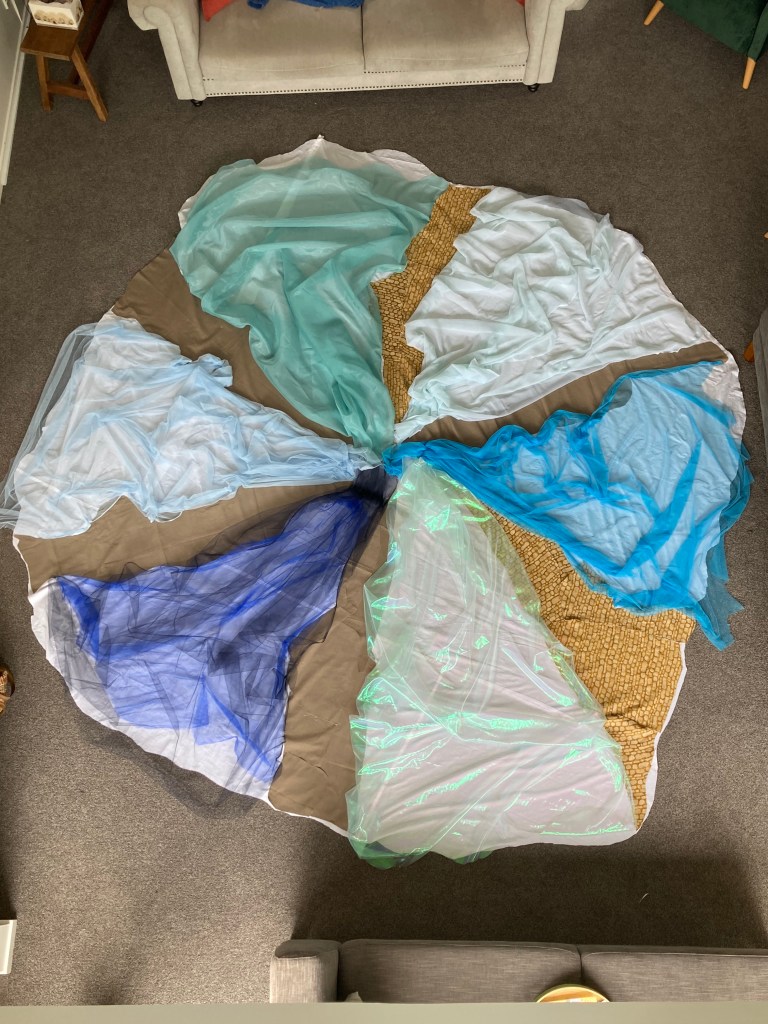
We did that because I’d been asked to co-teach an introduction to the six streams to the new ministry interns, so I made a six streams interactive art installation and was keen to see what you all made of it, especially since I know some of those streams can feel… polluted. I am among many who struggle to be open to the goodness in a stream that has placed a particularly strong emphasis on particular scripture excerpts to silence my voice and reduce my agency, for example.
So the plan is to revisit each of the six streams and see if there might be ways to engage with the tradition that allow us to acknowledge the shadow side of over emphasis and to see more clearly how a shallow perception of the tradition actually distorts its essence, AND at the same time to find fresh and refreshing ways we can draw deeply from within its banks.
Part of my uncertainty about whether this plan will really work for us is that the Renovare folks themselves offer resources which make me want to offer them a shit sandwich. I’m reading their stuff with my alarm bells ringing and it’s just harder to find the gold and focus on it when there’s quite a lot of dross to move to the side. I am going to start our exploration of each stream acknowledging the shadow parts I can see – this is often what I see first anyway, so it’s going to help me to get them out of the centre of my focus and let me see more of the good stuff there. I KNOW the streams all flow from the Source and that there’s something worth searching for in each of these, so I guess we’ll see what we find…oh, and I’m going to mash this six streams stuff together with Diana Butler Bass’ insights from her book Freeing Jesus, where she explores six different ways we know and relate to Jesus.
The Resources
Jesus as Teacher and the Evangelical Stream.
The evangelical stream is tagged as the word centred life. For those who are up to their ears in this stream, they probably want me to use a capital W for that word, and any other word that is used for Holy Writ. I may as well say upfront that this stream is triggering for me given how I experienced that emphasis on ‘what the bible says’ as very narrow in its approach, limited in its understanding of context and perspective, repressive of questioning, and particularly biased in its interpretation. When we first began the Unusual Bookclub five years ago, some of you greeted the invitation to dwell with scripture in those first posts with dismay, and I totally understand that.
Part of the shadow side of the evangelical stream is that when it is central, it’s often also exclusive – as in, the other streams are suspect because they aren’t (so obviously) based on the Word. With that one eyed kind of superior stance and judgement, the trust of faith becomes the assurance of certainty. It’s just a short hop to “the bible says….so it must be true”… true always and in every circumstance and for every person. It’s the zeal of certainty that only has space for either or, and cannot conceive of a world where God would tolerate, never mind be delighted by both/and.

The Book seems to give authority to those who read it and preach about it, it validates a particular form or structure or worldview and there is no arguing with it. I was taught the meaning of parables, told what the point of the story was, and instructed how to apply the lesson. Also, much warning of dire consequences for failure.
Diana offers something very helpful in this. She points to the opening sentences of John’s gospel:
In the beginning was the word, and the word was with God, and the word was God
1:1
Most Christians would probably say that the ‘word’ mentioned here means the bible. Yeah, Jesus, but also the Bible. God and the bible are somehow one and the same thing. Jesus is the Living Word (aka, the bible). There is even a bible translation called Living Word. You can see how this has happened. Except that this is actually a poor translation of the Greek. I’m going nerdy on you here, but bear with me…you probably know that the word John used is logos, which means….’ground’ or ‘speech’ or ‘expectation’. It doesn’t mean word like a collection of letters forming a part of speech – the Greek word for that is lexis (as in lexicon). Diana says:
The logos – the very ground of divine being, the breath of God, the presence of the holy in and through all things. John equated Jesus with the logos.
Freeing Jesus p.54
And Pete Enns, whose book How the bible actually works I read last year throws another option out there for us when he says the bible is:
an invitation to join an ancient, well-traveled, and sacred quest to know God, the world we live in, and our place in it.
The evangelical stream in the Renovare materials encourages us to live a Word centred life. From within this stream, they say that God uses three central ways to reveal himself (sic) to us: living word (Jesus), written word (bible) and spoken word (evangelism), and it is the last, the proclamation of the gospel that is at the core of the word-centred life.
So, the focus of this stream is toward others, looking for ways to teach, tell, connect and transform.
Pause to reflect
What has been your experience of the word centred life? Can you find a compassionate, non-judgemental place to stand and observe those experiences that allows you to see this part of your path more fully – giving the real weight to the pain and suffering that may be present, and to also see beyond, around and beneath that?
Are there aspects which have been enriching for you? How has your journey been shaped by others connecting with you as they tell their stories of grace, joy and transformation?
We have explored this before, so I want simply to acknowledge that in this stream I listened to evangelists, preachers and worship leaders whose message connected me to a sense of deep shame, guilt, grief and fear. The transformation offered seemed like a constant two step process – a step back and down into the wallowy pit of awfulness that is my constant human condition of fallenness, and then I am thrown a thin lifeline of hope that despite all this God still – albeit unaccountably – loves me and is willing to haul me out once more and sluice me off. It’s not a story of joy and healing you can tell over and over because it doesn’t really change. Which means if you are going to proclaim this, (as the evangelical stream encourages you to) you’re going to need regular access to a new audience. In the distorted version of this stream, journeying is more about not ‘backsliding’ and making sure you follow the rules (whatever they may be).

If this stream is going to offer something fresh in terms of how we speak about God’s presence and action in our lives, then I think it has to be more about sharing all the stories of life which helps us to live fully into the pain, grief, anger and failure as well as noticing and celebrating those times of joy, grace, compassion and healing.
What do you think?
If it’s going to offer something fresh in terms of how we engage with the living word, then it has to help us connect with Jesus as our teacher and the embodiment of the rule of love as a way of life to be followed, a way to be fully and completely human. We have to be able to question, laugh and argue with, and learn from Jesus – like we would with any good teacher.
How does that sound?
And if it’s going to offer something fresh in terms of how we listen, lean into and dwell with the written word…well, we’ll need to practice listening, leaning in and dwelling. Even when it is really uncomfortable. Or boring. Or whatever.
Does that make sense?
The Practices
A listening practice

This comes from Dr. Chatterjee’s journal, and it is brilliant in its simplicity.
At the beginning of each day, take five minutes to ask yourself three questions:
- What is the ONE thing I need to do today? Resist the urge to list more than one. Resist the urge to use this as the shortest, most achievable To Do list ever. Pause, breathe, consider the week past, the day ahead…what is the ONE thing, the most important thing?
- Who are you grateful for right now? When a person (or furry companion, perhaps) comes to mind, pause for just a moment and remember how you feel when you are with them, what it is that warms your heart or fills you and lifts your spirit?
- What is one quality you want to show the world today? And what might that mean for the day ahead? Where might it be harder to show up with that quality? Imagine how you will hold yourself in those spaces.
Listen to your life…listen to the Spirit at work in quiet ways…
A Dwelling Practice
6-7 My counsel for you is simple and straightforward: Just go ahead with what you’ve been given. You received Christ Jesus, the Master; now live him. You’re deeply rooted in him. You’re well constructed upon him. You know your way around the faith. Now do what you’ve been taught. School’s out; quit studying the subject and start living it! And let your living spill over into thanksgiving.
Colossians 2, The Message
You may want to pick out the words that draw you in and see what they bring forth as you journal; you may want to pick an argument with Paul or ask him what he meant by this or that word or phrase…I get the feeling he’d enjoy that kind of exchange; you may want to find your own words or draw your response to this passage…a tree? a building? a flat pack cabinet with instructions in Danish? What does your tree look like? What does your building look like? What does living it look like now? already?
A connecting practice – Drawing implications

This is a listening skill which helps to bring hidden connections into the light by expressing possible unspoken expectations or emotions. It is an empathic attempt to name reality for the other person so they can explore….so, for example, ‘you already went through a big change at work, and even though this is different, and you are in a different position, the fear of it being like last time is really big’ . There is every possibility you may not be accurate in your implications. You may make a connection they can’t see, or don’t feel but it opens a door for deeper exploration and chances are good that they will feel affirmed and validated and know that it is safe to accept their own experience and you are willing to be with them in it.
It’s a skill you can practice on yourself too, as it can teach you how to listen more deeply to your own life – a bit like having an internal version of your supervisor/therapist/most insightful friend. You can learn how to be present to yourself, and practice making the connections and asking the question.
 an unusual book club