

The Resources
As I’ve listened to stories of people who have been through a faith deconstruction and/or re-formation, and reflected on my own experience, one of the things that stands out is the grief over losing a sense of community. For some, leaving the church means losing all of their social connections, perhaps because those who remain believe that there is no salvation outside of the church. Who can blame them, since that claim was made in the 3rd Century and goes along with the claims of exclusivity which Christianity has also held onto with limpet-like grip? So to leave seems like a betrayal of everything and everyone, including the God you’d previously professed to love, obey, worship etc. etc.
Leaving church, when it has held a central place in your life is hard. I think it’s meant to be – not for healthy reasons.
While looking for something else, I found an article in Christianity Today which addressed this reality of church life, (full disclosure, I skim read it) and it was interesting to see how they rather artfully avoided looking into the reasons why one might choose to leave, alluding to a community moving ‘toward unbiblical theology, unhealthy leadership or dysfunctional relationships’. All I can say is there’s lots of room for interpretation there!
I have left churches, and gone on to find other churches. So far, my intention hasn’t been to leave The Church, just the one I had been trying to belong to. And that, I think, is where the healthy/unhealthy part gets messy.

Pause to reflect
Does belonging require work? What has your experience been?
Brene Brown says that belonging is about being accepted for your whole, imperfect, authentic self, not about fitting in. Fitting in means hiding parts of yourself, either completely or through behaviour modification while in polite company. So you have to work to fit in. But you don’t have to work to belong. Belonging is not something you hustle for, because everyone, everyone is worthy of belonging – because everyone is imperfect. And so everyone is, at times, dysfunctional in one way or another to one degree or another.
And we’re all on a journey….which usually means we’re moving towards something like this:
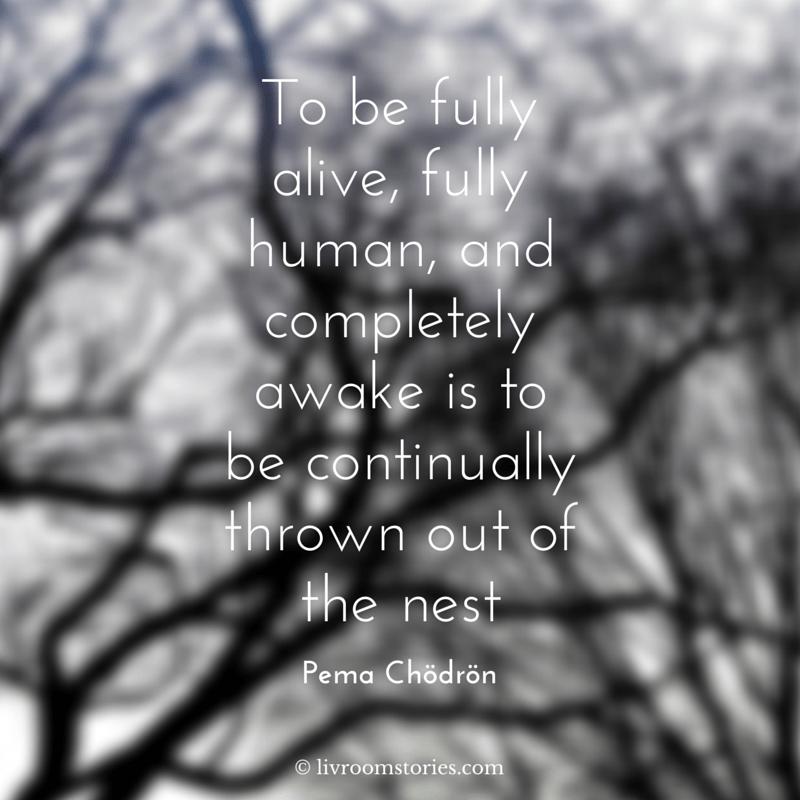

Have you had a ‘thrown out of the nest’ experience? What’s it like for you to look back on that now? What do you notice? And, what do you notice as you contemplate this being a continual experience, a consequence of awareness, openness, courage and acceptance?
Some years ago I read Barbara Brown Taylor’s book Leaving Church: A Memoir of Faith, which she describes her journey from parish priest to college lecturer:
This is not the life I planned, or the life I recommend to others. But it is the life that has turned out to be mine, and the central revelation in it for me — that the call to serve God is first and last the call to be fully human — seems important enough to witness to on paper.
The journey doesn’t take us where we thought we were going – probably just as well – and the disorientation/reorientation that happens every time we are thrown out of the nest is real. So how do we nurture, practice and live into belonging when the model most of us experienced is one of fitting in?

Well. I think it may have something to do with friendship.
Sometime in the last couple of months I listened to an audio book about friends called The Life Council – ten friends every woman needs. I enjoyed listening, and even though it is very woman centred and, in particular, very California woman focussed, it still offered some helpful insights into the art and practice of friending. One of the things that was especially insightful was her initial framing of friendship. Friendship is a to do. It doesn’t just happen, and it doesn’t just happen from an initial effort and then become self-sustaining.
We’re more connected to everyone we’ve ever met, thanks to the internet, and yet we’re lonelier than ever.
The Life Council
In fact, for most of us, friendship did sort of just happen, at least in our earliest experience. Most of us made friends kind of by accident – who you sit next to at school, who is in the same classes as you, who is on the same sport team/plays in the band/shares the same niche interest or has the same classroom social status as you. We made friends with the kids we saw every day, and while we did make plans to hang out outside of school hours, most of those plans got made during school hours. The framework for our interaction was given. Once you leave school, this kind of daily being together happens at lot less at work or at university, if it happens at all. And because most of us didn’t make friends with a high level of conscious intentionality, most of us don’t know quite what to do when we have to make more effort – when we have to be intentional about making and keeping friends.

Church offered that framework again – not just a Sunday morning gathering, but also Sunday evening for that more relaxed (and somehow also more intense) worship service; for the prayer group meeting, the bible study meeting, the women’s/men’s group, the youth group, the leaders this and that, the music team/liturgical dance practice, the drama group, the banner making, evangelism training, alpha, service team…all of that gave a framework for finding and making friends and maintaining those relationships through repeated connection and sharing.
So leaving church, or when church doesn’t have the group meetings to form the framework to develop bonds (or just keep things humming along ) – also means losing the ease of belonging (or the facsimile of it).
Pause to reflect again
How do you make friends? (have a think about this with different emphases…how DO you make friends? How do YOU make friends? )
What do you do to keep friendship warm and vital? What do you do when friendship goes cool? What does it mean to you to be a good (or bad) friend? How has it been for you to lose friends? How do you handle things when there is tension like a difference in financial status or a drifting apart?
Laura (Life Council author) identifies ten different kinds of friends that she feels are invaluable. They may not all be for you, but I’ll list them:
- the daily duty friend is likely to pop in unannounced, ignore whatever mess your house is in, make themselves a cup of tea, set a bottle of your favourite whatever on the counter because it was on special at the supermarket…every day comfortable around you.
- the old friend has known you for long enough to chart your growth, and has been through ups and downs with you over the long haul.
- the battle buddy is going through the same kinds of struggles with the same issues.
- the business bestie is your work friend who you maybe don’t see outside of work, but you support each other when you’re there.
- the new friend – the open space of possibility where you put in effort to get to know someone new, never closing off the chance of a meaningful new connection.
- the soul friend – she admits not everyone has someone who fits this space, but she also is convinced everyone has a soul friend, you just might not have found them yet (possibly you haven’t left room for a new friend?)
- the password protector. Someone you actually do tell your passwords so that in the event of emergency, they can access your stuff and do what needs to be done.
- the ‘yes’ friend – the one who knows how to have fun and is up for stuff.
- the fellow enthusiast, who you can talk for hours with about stuff that other non-enthusiasts find excruciatingly dull.
- the mentor, who offers wisdom and guidance when you know you need it, and not when you don’t.

Also key in these relationships (and not always learned well at school) are the need for boundaries, a willingness to share difficult emotions and navigate the pain points of relationships as well as a willingness to persevere, offering ongoing invitations and accepting them.
Are those things that have characterised your friendships and/or your experience of belonging in church groups?
The Practices
A friend of God – audio divina
Listen and be alert for what speaks to you…what surprises or catches your attention…what is jarring or evokes some discomfort…what warms you and brings you consolation.
visio divina
This image is of Jesus, with his arm wrapped around an abbot’s shoulder…the eyes are huge in Jesus’ face, the warm browns he is painted with add to the soft glow around him. The friendship, the offering of invitation and the encompassing acceptance…how do they speak to you? What do you see here?

Life Council collage
However you like to craft – with words, cut and paste from photos, paint, colour, draw – who is around your friendship table, which seats are empty, what would you like to see here….and what might you do to begin to move toward that?
 an unusual book club