

The Resources
“The story I’m telling…” Part one of the rumble process
In the first Rising Strong post I said that Brene identifies three distinct stages in the process of getting up after a fall and staying open with your whole self. The first stage is an honest reckoning with emotions which requires both compassion and curiosity, so there’s no judgement about what you feel (shooting the messenger is never helpful) and there’s also an intentional effort to dig a bit deeper. Digging deeper moves us beyond the surface feelings, which is important because sometimes what is immediately apparent (I feel angry/ I feel anxious/I feel sad) hides a more intense emotion that lies beneath (I feel abandoned/ I feel overwhelmed/I feel lost). Curiosity with compassion creates a space to wonder why do I feel…what else is happening for me…what does this remind me of…? In essence, what’s the story I’m telling?
This part gets messy and if you want to get back up and live wholeheartedly, if you want to live fully awake then there’s just no way to avoid the messiness. There is no shortcutting this process because the learning happens in the messy middle. This is the journey. There is an alternative, of course, and it’s the numbing, avoiding, bouncing, chandeliering etc. There’s a time for that, too, I think. There’s a time when the messy middle is not safe to enter alone, or you just don’t feel ready and then your ineffective but deeply ingrained defence strategies are part of the messy middle itself. Rumi’s poem ‘homage’ offers us a wise perspective:
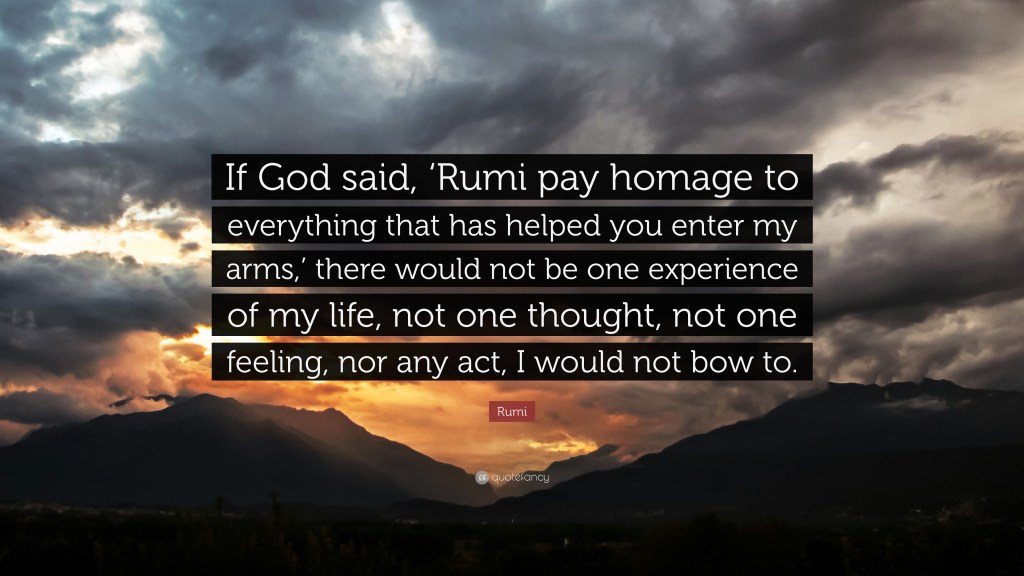
So, everything you choose now that seems to lead you away from wholeheartedly living your fullest, most beautiful life is, eventually, going to count as one of the things that leads you into the arms of Love.
How does that sit with you?
The reckoning of emotional responses to an experience of ‘falling’ allows you to walk through the story of that fall with awareness and to catch yourself in the act of story formation. This is where you rumble with the story you tell about your struggles and do some reality checking.
Nearly half of the book is Brene’s rumbling with stories that deal with boundaries, shame, blame, resentment, heartbreak, generosity and forgiveness – they are not all her personal histories, but they are all real stories.
The rumble is a journey in and of itself. The first ‘rough draft’ story I tell about something is a mishmash of defensive strategies, interpretation, habitual explanations and expectations of myself and others. There’s real data in there, but it’s blended seamlessly in my mind with some imagined motives, some past history, and some creative hypothesising which is all wrapped up with my emotional reactions. This first story makes sense to me, though. It makes sense because I don’t easily acknowledge that I’m working from limited data which I haven’t checked – I haven’t checked with the reality of the others who are part of the falling story, and in that first ‘rough draft’ story I usually haven’t checked with my own fullest reality.

There are lots of different elements that might form part of your rough draft story. Brene calls it the Shitty First Draft, I suspect because many of the elements that we begin with are just crap, really. Blaming, shaming, guilting, not enoughness, unworthiness, do bettering, victimising, uselessing, stupiding…they’re likely to show up in some form or other as part of the story you make up. She also highlights three dangerous inner narratives that destroy your sense of self-worth and your relationships with others.
First there are stories that say you are unlovable or unworthy of love. If you have been betrayed, rejected, or abandoned, if you experienced a distant or uncaring relationship with a parent or family member then often the story that makes sense of it is that you are unlovable or that you did not do enough to deserve to be loved.

“But just because someone isn’t willing or able to love us, it doesn’t mean that we are unlovable.”
Brene Brown
Then there are stories that say you are essentially unworthy. If you have been shamed for being you, if you received the message that you are inherently flawed then the story that makes sense is that you are undeserving of life itself. The doctrine of original sin is ringing in my ears right now – it taps into this deep sense of lack but I reckon it’s actually a classic Shitty First Draft that could use a reality check with the bigger Truth of the Judeo-Christian tradition.
“…no person is ordained to judge our divinity or to write the story of our spiritual worthiness.”
Brene Brown
Lastly, there are stories that say you have nothing of worth to offer to others. These stories are formed in response to experiences where we were shamed as learners in school or shamed for our creative expression – writing, art, music, dance or any other kind of creative act. When our creativity is met with a standardised measuring stick and found wanting, we create a story that we are not creative.
“just because someone failed to see the value in what we can create or achieve doesn’t change its worth or ours”
Brene Brown

When these stories are doing their work on you, it’s actually shameful to admit to them – they rob you of your voice. So it’s a vital first step to speak their awful version of truth so you can bring it into the light and check it against a fuller reality.
A Pause to Reflect
Brene talks about her ‘not enough’ story that pushes her to try harder, do more, be better even when she’s exhausted. What’s your go to story that makes sense of the world for you?
What are the stories that you’ve heard from your faith tradition that have accentuated the story you already tell? How are you holding those faith elements now? Have you experienced healing for those wounds and how did that come about?
The Practice
Write a really, really shitty first draft
No one is going to see this. You can say whatever small minded, petty, self-centred, angry thing you like. You can get sentimental and weepy – your five year old self can really go to town here and throw a tantrum with no bad fall out. Don’t short change yourself and the process by trying to be tidy, rational and all that – you don’t have to impress anyone or protect anyone from this unvarnished version of your ‘story I’m telling’.
Here’s what you need to capture:
- My emotions
- my body
- my thinking
- my beliefs
- my actions
That’s it. You can be creative about how you capture those elements of the SFD – story board them, make a video, cartoon it, scrapbook it…make a children’s book about it…

 an unusual book club